%20transp.png)
IVF vs IUI Treatment: Which Is Right for You?

A fertility recommendation can feel like a major fork in the road, especially when you have already spent months tracking cycles, completing testing, or coping with disappointment. The question of IVF vs IUI treatment is not simply which option is more advanced. It is about which approach gives you a reasonable path forward based on your age, diagnosis, timeline, and family-building goals.
Both treatments can be appropriate. IUI is less involved and can work well in carefully selected situations. IVF offers more control over fertilization and embryo development, and it may be the more efficient recommendation when there are factors that make IUI less likely to succeed. A thoughtful decision begins with understanding what each treatment can, and cannot, address.
IVF vs IUI Treatment: The Essential Difference
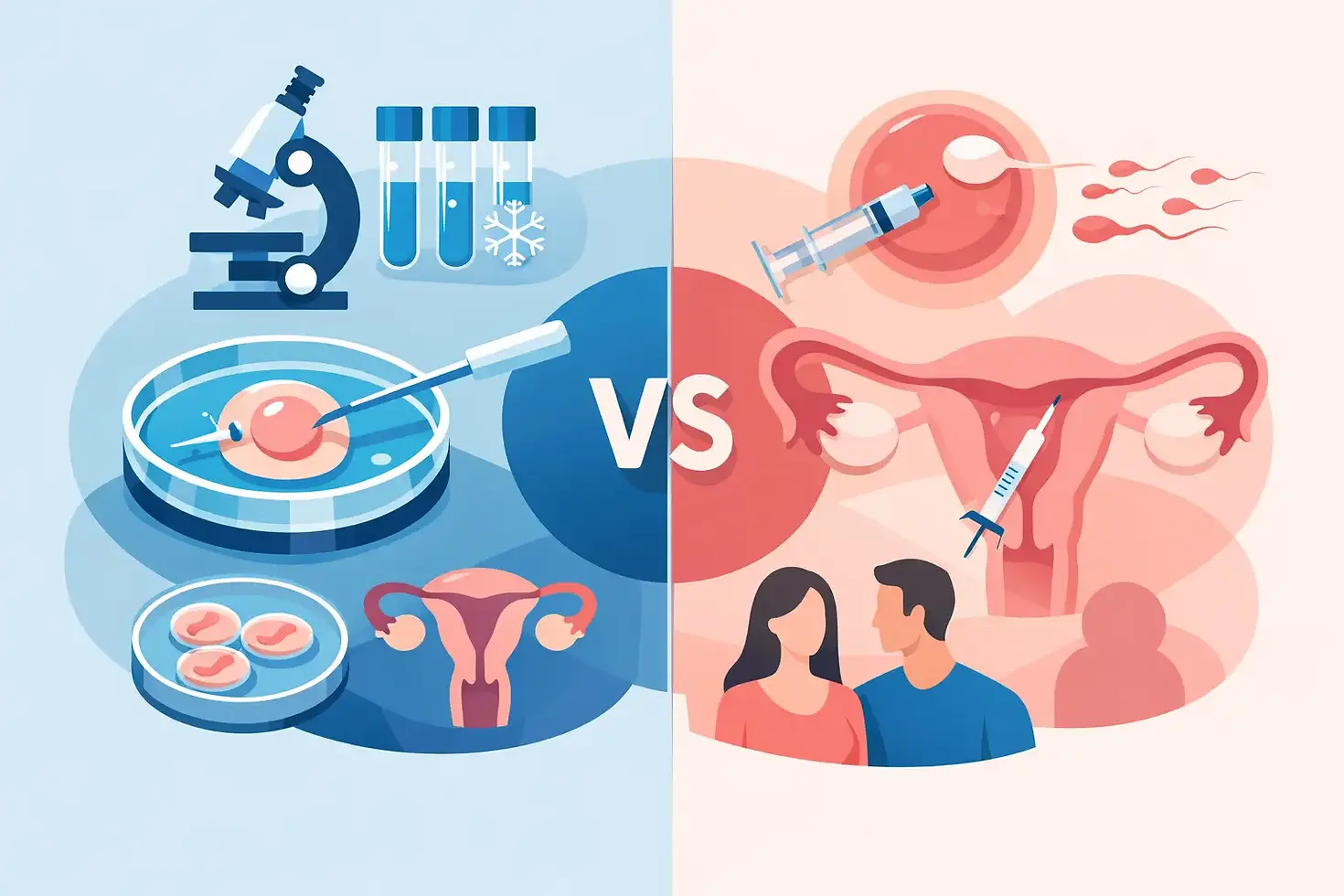
Intrauterine insemination, or IUI, is performed around the time of ovulation. A semen sample is prepared in the laboratory, where the most mobile sperm are concentrated, then placed directly into the uterus through a thin catheter. The goal is to bring sperm closer to the egg and reduce barriers at the cervix.
IUI may be completed in a natural cycle or with medications that encourage the development of one or more eggs. Fertilization still occurs inside the body, in the fallopian tube. For that reason, IUI depends on open tubes, predictable or medically supported ovulation, and sperm parameters that are suitable for this approach.
In vitro fertilization, or IVF, involves stimulating the ovaries, retrieving eggs, and fertilizing them in the laboratory. Embryos are observed as they develop, and an embryo can later be transferred to the uterus. IVF does not require open fallopian tubes because fertilization happens outside the body.
IVF also creates options that IUI cannot offer. Depending on the clinical situation, this may include ICSI, where a single sperm is placed into an egg, or preimplantation genetic testing for aneuploidy, known as PGT-A. PGT-A can help identify embryos with the expected number of chromosomes, but it does not guarantee pregnancy or replace individualized medical counseling.
When IUI May Be a Reasonable First Step
IUI is often considered when the fertility evaluation is reassuring overall and there is a clear reason to believe sperm and egg can meet successfully after insemination. This can include ovulatory dysfunction that responds well to medication, mild sperm-related concerns, unexplained infertility in younger patients, or the use of donor sperm.
It may also be a reasonable option for patients who want to begin with a less intensive treatment while their prognosis remains favorable. However, a recommendation for IUI should not be automatic simply because it is the first treatment on a typical ladder. The details matter.
Before recommending IUI, a physician should review whether at least one fallopian tube is open, whether ovulation is occurring or can be reliably induced, the ovarian reserve picture, uterine findings, semen analysis results, and how long pregnancy has been attempted. A history of pelvic infection, endometriosis, prior ectopic pregnancy, or pelvic surgery may also affect whether IUI is a sensible choice.
For some patients, several IUI cycles are reasonable. For others, repeating IUI after unsuccessful attempts may only add time without meaningfully improving the chance of success. The goal is not to pursue the most treatment cycles. It is to choose the strategy that makes clinical sense for your circumstances.
When IVF May Be the Better Strategy
IVF is commonly recommended when there are blocked or severely damaged fallopian tubes, significant male-factor infertility, severe endometriosis, or a history suggesting that fertilization may be difficult. It is also often considered after several unsuccessful IUI cycles or when prior testing has not explained why pregnancy has not occurred.
Age and time can be important parts of this decision. As egg quality changes over time, the value of gathering information from eggs and embryos may become greater. For patients in their late 30s or 40s, IVF may offer a more direct route than multiple IUI attempts, although the right choice remains individual.
Patients with low AMH, diminished ovarian reserve, or a prior poor response to stimulation also need a tailored conversation. Low AMH does not mean pregnancy is impossible, and it does not automatically mean that one treatment is right for everyone. It does mean that treatment planning should be careful, realistic, and led by someone who can interpret the full clinical picture rather than relying on a single laboratory value.
IVF may also be preferred when embryo testing is part of the family-building plan. Because IUI does not create embryos in the laboratory, it cannot provide information about embryo development or chromosome screening before pregnancy.
Success Rates Are Personal, Not a Single Number
It is understandable to search for one success-rate comparison between IVF and IUI. In practice, a single number can be misleading. Outcomes vary with age, egg quality, ovarian reserve, sperm factors, tubal health, embryo quality, uterine health, and the diagnosis behind infertility.
In general, IVF has a higher chance of pregnancy per treatment cycle than IUI because it allows fertilization, embryo development, and transfer to be managed more directly. But higher per-cycle success does not mean that every patient needs IVF first. An IUI cycle may be appropriate when the probability is reasonable and the underlying conditions support it.
It is also helpful to think in terms of cumulative opportunity and time. A treatment with a lower chance per cycle may still be a suitable starting point for one patient. For another, particularly where time is more limited, moving to IVF sooner may reduce the risk of spending months on a path with low expected benefit.
The Treatment Experience: What Changes Day to Day
IUI is usually simpler from a scheduling perspective. Monitoring may include ultrasounds and bloodwork, followed by an insemination appointment timed to ovulation. The procedure itself is brief and generally feels similar to a gynecologic exam, though some patients experience mild cramping.
IVF requires more planning and monitoring. It includes ovarian stimulation injections, ultrasound and hormone monitoring, an egg retrieval procedure, laboratory fertilization, embryo culture, and embryo transfer when appropriate. Not every IVF cycle follows the same schedule. Some patients benefit from a fresh transfer, while others may have embryos frozen for transfer in a later cycle based on their response, hormone levels, or testing plan.
Neither approach should feel like a standardized checklist. The medication plan, monitoring schedule, laboratory strategy, and embryo transfer timing should be adapted to the patient, particularly after previous unsuccessful treatment or an unexpectedly low response.
Questions That Help Clarify the Right Path
A productive fertility consultation should leave you with more than the name of a treatment. It should help you understand the reasoning behind the recommendation. Consider asking:
What is the specific diagnosis or concern that treatment is meant to address?
Is IUI likely to offer a meaningful chance of success in my situation, and how many cycles would be reasonable before reassessing?
Would IVF address a barrier that IUI cannot, such as tubal disease, sperm factors, or fertilization concerns?
How do my age, ovarian reserve, and timeline affect the recommendation?
If IVF is recommended, would ICSI or PGT-A be medically useful for my circumstances?
The answers should be clear, individualized, and honest about uncertainty. Fertility medicine involves probabilities, not promises. A physician who knows your history and remains involved in your care can help make those probabilities easier to understand and act on.
Choosing Care With Continuity and Clear Planning
For patients traveling from the United States or Canada, the clinical decision between IUI and IVF is only one part of the experience. Remote planning, timely review of records, and clear coordination can reduce unnecessary stress before treatment begins. When care takes place in Cancun, a well-organized pathway should still feel personal: you should know who is reviewing your response, what each step is for, and when to expect decisions.
The right treatment is the one that reflects your medical reality and your goals, not a generic protocol or a rushed recommendation. Whether IUI is a sensible first step or IVF offers the stronger path forward, clarity is often the most valuable place to begin.


I visited an IUI fertility clinic in London because I wanted a simpler fertility treatment option that suited my circumstances. The specialists took the time to understand my situation and explained how the treatment would be monitored and timed. I was very happy with the professional care and clear communication I received.